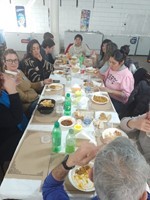
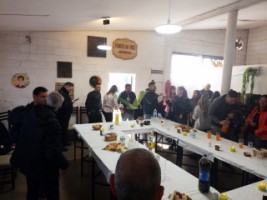
This restaurant operates within the cooperative's territory, one hundred percent managed by incarcerated people, inside the maximum-security penitentiary of Batán — an unprecedented development.
For this occasion, invitations were extended to individuals and institutions connected to the prison sphere, with a special focus on victims.
Reception and Participants
From early in the day, visitors could be seen arriving to share this meaningful moment alongside the Liberté family. They were initially welcomed by coordinators of the space, including pampa, Carlitos, and others. It is worth noting that the majority of those in attendance were victims brought together under the organization led by Diana Márquez.
The group that attended from Víctimas por La Paz was made up of: Alberto Siebenhaar, Sergio Nuñez, Constanza Setrini, Alejandra Álvarez, María Davalos, Damian Mereles, Alejandro David, and Diana Márquez. A meaningful detail of this gathering: Mario Juliano was the founder and guiding mind behind Víctimas por La Paz.
Celebration and Strengthening of Bonds
Many of them, coming from different towns and provinces, had the chance to meet one another in person for the first time — making the most of this joyful occasion not only to celebrate the restaurant's opening, but also to deepen their relationships: among themselves, and with the incarcerated people of the space.
They then made their way to the cooperative's workshops, located in the medium-security sector of the prison, where the most beautiful mural in the world can be found — designed by visual artist Juan Carlos Comperatore and the art school of Necochea, proposed at just the right moment by those gathered within Víctimas por la Paz, whose coordinator is Cooperativa Liberté member and notary Diana Márquez.
Workshops and Activities
There, in that same sector where Liberté first took root, the leatherworking and carpentry workshops now operate alongside the plant laboratory, which receives technical guidance from INTA.
Visitors could observe the daily work being carried out — visible in the pieces already produced across the different areas.
Tour and Opening of the Restaurant
Both pampa and Carlitos, coordinators of Liberté, also took on the task of offering a historical overview of the institution — one that has been managed entirely by incarcerated people from the very beginning. They took care to acknowledge the support of Mario Juliano in those early days, and the enduring accompaniment of victims ever since: people who, while they speak of the serving of sentences, equally speak of the importance of those sentences being served in conditions of wellbeing, so that genuine restoration can take place.
The tour continued through the different areas: the organic vegetable garden, the pantry, the organic chicken coop, the carpentry workshop, the library, and the textile sector — until the group finally arrived at the restaurant dining room, where, after some words befitting the occasion, Restaurante Punto de Paz was formally inaugurated.
Tasting and Artistic Activities
Guests enjoyed a spread of cold cuts, pizzetas, and sandwiches made with a flavorful pork leg, accompanied by soft drinks and a delicious cake for dessert.
Another member of Víctimas por La Paz, who is a rapper, also took the opportunity to liven up the gathering with his skills in urban expression.
The Restaurant and Its Meaning
This idea has become reality through a proposal made at just the right time by Víctimas por la Paz and Liberté, with furniture and tableware donated by Diana Márquez — a commitment to "restoration". The thinking behind it is that it matters deeply for incarcerated people to have the possibility of living through situations similar to those experienced outside the walls: aiming for a restoration of their lives, so that when the moment comes to return to their world — their city, their neighborhood, their home — they do so restored. They will have been incarcerated, yes, but they will have been able to live that time of their sentence as close to life outside the walls as possible: working, building skills in different workshops, taking courses across various specialties, and enjoying a space that today is a factory of opportunities — Liberté. For example, sitting in a dining room where food is served, where you can ask a fellow worker acting as waiter for a menu listing the dish of the day or other meals prepared by people working in gastronomy right there — all of it unfolding like something you might find at any corner of any city. This is a true example of RESTORative work.
Future Prospects and Visits
The possibility of going to a restaurant and sharing time with friends over a meal — and perhaps in the future welcoming family members, friends, or the many people who visit Liberté daily — is exactly the kind of vision expressed in a recent interview carried out by Prensa Liberté with the person who has been the soul of this project.
Guests and Participants
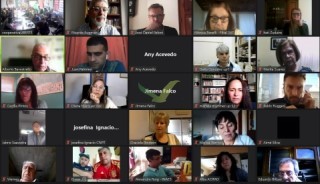
Among the guests, as mentioned, were victims and various members of Víctimas por La Paz, Alejandro David, who serves at the Juzgado de Ejecución de San Martín, Claudia Cassinelli, a textile worker, Luz Mirella, who currently trains incarcerated workers at the sewing workshop in garment-making, Canela Bella from the organization Proyecto Mecha, Roberto Gandolfi, city councilmember for the Frente de Todos, Iris Garzón and Adolfo Javier Christen, who work at the Public Defender's Office of the Autonomous City of Buenos Aires and also serve as vice president of the association created by the late Judge Mario Juliano, Pensamiento Penal was also represented, as was Lisi, widow of that same judge — whom Liberté continues to honor with the title of godfather of the space — Ricardo Augman, from the Procuraduría Penitenciaria de la Nación, working in the program "Marcos de Paz," Ani Acevedo, dialogue facilitator in the context of incarceration within the program "Probemos hablando," Lidia Pérez and Claudia, representative of INADI, Eleonora Suárez from ACIFAD, representatives from INTA, Silvia Pessolano and Mauricio Navarro, former members of Liberté now living in freedom, longtime neighbor and collaborator Mauricio Alfredo Tótaro, Nancy Caballero, Julieta Torres, both social workers within the SPB, Pablo Bricker, radio worker, Patricio, a collaborator with Liberté in gastronomy, Patricia Taja, who donated the industrial machinery to our carpentry workshop, Adrián Eche and Damián Bor, Jimena Falco, who works at the Unidad de Letrados Móviles 1 de Ejecución de CABA (DGN), incarcerated workers of the space, founding members of Cooperativa Liberté and members of its Board of Directors, among them Matías Tótaro, Xavier Aguirreal, Carlos Tótaro, and Diana Márquez, of Víctimas por la Paz.
Source: Prensa Liberté