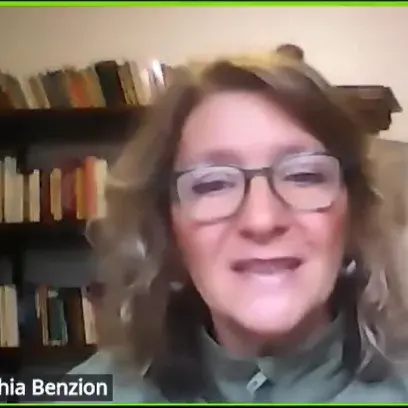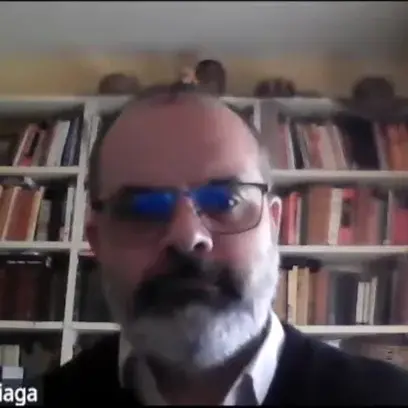

From Unit 15 of Batán — a maximum-security prison that is also Liberté territory — and simultaneously by video call, more than eighty people sat down one Saturday morning to study the labor reform. The format was hybrid: around sixty-five connected via Zoom and twenty-three present in the room. The class was taught by two labor lawyers, Cynthia Benzion and Leonardo Elgorriaga, and the title said it all: «La Ley de Modernización Laboral como destrucción de las conquistas sociales».
Pampa, president of Cooperativa Liberté, opened by thanking the speakers and the community: «Universidad Liberté is what people need, what we need». What followed was not a lecture but a nearly two-hour conversation — with questions from the room and from the chat — that traced a century of labor law to understand what is being lost today.
A tribute before we began
The gathering opened with a farewell. The session coincided with the death of Carlos «Indio» Solari, and the community felt it. «It is a difficult day for me», said Diana Márquez, a member of the cooperative's Board of Directors, and she recalled the song «Graciosos y valientes» by Patricio Rey y sus Redonditos de Ricota: «Being happy is always a revolution inside prison, and outside too».
Ricardo Augman, also from the Board, added a phrase he had read that early morning: «Carlos Solari has died, but the Indio never dies». For him, Indio was above all «a community builder», an inspiring figure beyond who enjoyed his records or his concerts the most.
Márquez drew one last thread, toward the Proyecto Mecha that Liberté recently concluded: the name came from a verse by Indio, «de qué lado de la mecha te encontrás». With the tribute paid, the class began.
Watch the full class on EduTube.
A century of labor law, to understand what is at stake
Benzion proposed starting with history. «I think going back to what labor laws are and how we got to today allows us to understand a little better» what is at stake, she said. And she went back to the 1949 Constitution, which during the first Peronist government prioritized the dignity of workers and established what are technically called minimum protection floors: what any working person must be guaranteed as a minimum. That constitution did not last long — the self-styled Revolución Libertadora came — and, paradoxically, it was during the de facto presidency of Aramburu, in the 1957 reform, that the Artículo 14 bis was incorporated into the Constitution.
Benzion shared that article on screen, arranging it into three parts: the rights of each working person, the rights of unions, and social security — retirees and pensioners. But she asked the audience to pause on its opening sentence, in force since 1957 and never amended. The text of the provision reads: «El trabajo en sus diversas formas gozará de la protección de las leyes, las que asegurarán al trabajador condiciones dignas y equitativas, jornada limitada, retribución justa». She underlined it this way: «This is not double protection for the employer and for the worker. It is one-directional protection. The law exists to protect the worker».

What does it protect from? From an inherent inequality. «If I need a wage to eat and support my family, I don't have much choice», she explained. In a country with structural unemployment, submission to employer power becomes almost absolute: «It's the "if you don't like it, leave", because there is a three-block queue of people willing to accept what you are not».
From that journey — and from the union surge of the seventies — came, in 1973, the decision to consolidate scattered labor legislation into a single body: the Ley de Contrato de Trabajo. The project was entrusted to a labor lawyer from Mar del Plata, Norberto Centeno, who represented more than eighty unions in the city. Benzion read what Centeno had in mind when writing it: «Work is inseparable from the worker». The law, she summarized, had to guarantee two things: the dignity of those who work and protection against abuse.
Against the common wisdom that repeats that labor laws are an obstacle to generating employment, Benzion was blunt: «This is false. The highest levels of employment in Argentina were achieved with fully protective laws that penalized employers who did not comply». That is why, she said, the current reform is of another scale: «It is frankly revolutionary», a break «with a logic and an order built over more than a century».
The historical account arrived at the dictatorship. Benzion showed a front page of Clarín from March 26, 1976. In large letters, the cover proclaimed that «la Junta es el órgano supremo del Estado»; in a side box, «el derecho de huelga quedó suspendido temporariamente»; and, alongside it, life continuing as if nothing had happened: «Habrá clases primarias y funcionarán los bancos». The military Junta was suspending the right to strike and union activity — the central tool workers have to defend their rights. She recalled that, according to CONADEP, more than thirty percent of the disappeared were workers, activists, and union leaders. And that a group of labor lawyers from Mar del Plata — including Centeno — was abducted in what became known as the Noche de las Corbatas: fourteen people taken to a clandestine detention center called «la cueva», tortured and murdered. To close, she screened a fragment of the Juicio a las Juntas, with the testimonies of María Eva Centeno and Marta García Candeloro, and the phrase their abductors told them: «Ahora, los que administramos justicia somos nosotros».
Three legs of the same plan
Benzion placed the current reform within a sequence. «It is not just this last labor reform», she warned: they are three measures chained together since the start of Javier Milei's government. First, DNU 70/23, from December 2023, which modified more than two hundred laws. Benzion recalled the photo of Federico Sturzenegger beside a stack of papers and hinted at who had written them: «They were the law firms of the major economic groups that for years had dreamed of eliminating the right to work». But, she said, the decree «backfired on them»: the Labor Court of Appeals, following an action by the CGT, declared it null in labor matters because there was neither necessity nor urgency.
«The guys learned», she said ironically, «and said: let's make a law and pass it in Congress». That is how the other two legs arrived: the Ley Bases, in force since July 2024, and the Ley de Modernización Laboral — law 27.802 — in force since March of this year, which «delivers the final blow».
The law that withdraws
Elgorriaga took over to go directly into the latest reform and individual employment law: the employment contract. For him, the thread running through the entire reform is one: «Let the State withdraw, let the protective labor law withdraw and leave the worker alone before the employer». He illustrated it with a name: «We have a Ministry of Deregulation; I think it couldn't be clearer».
He also dwelt on the label «modernization». The argument for adapting the law to new technologies, he said, is an excuse: «When you look at the content of this reform, you find that there is little or nothing related to new technologies». Where technology appears, it functions as a key to let the law retreat. The clearest example is platform work: the reform declares that the Ley de Contrato de Trabajo does not apply to that group — delivery workers intermediated by apps — and creates a scheme that does not recognize them as employees. «Highly precarious», he summarized. The same, he said, with remote work: the law enacted during the pandemic is repealed with no replacement. And with maritime crew members, who also fall outside the Ley de Contrato de Trabajo.
When the law excludes those who work in prison
This point hit the present community directly. Elgorriaga explained that the Ley de Modernización Laboral expressly states that the Ley de Contrato de Trabajo does not apply to people in prison who work in detention units. And it goes further: it amends the Prison Execution Law itself. «Reforming Article 107, which previously stated that work in prisons must conform to labor and social security legislation — that is eliminated; and along the way they eliminate the right for it to be paid work». The summary was blunt: «I am no longer going to protect you». And the contradiction, obvious, against Artículo 14 bis, which begins by stating that work «in all its forms» shall be protected by law.
That contradiction ran through the interventions from the room. Marcelo Pereyra told his case: he worked more than three years as a health promoter and, as he recounted, they had him sign the payslips but never paid him what he was owed. «How does one go about claiming that?», he asked, and raised the difficulty of doing so «without having a labor lawyer». Elgorriaga replied that, since this was a debt prior to the reform, his case is still covered by the old law's protection; and that, in any scenario, the right to a wage is a fundamental human right: «This can never be unpaid work».
Benzion added a technical reading. Even if it were accepted that people in prison had been left outside the Ley de Contrato de Trabajo, she said, the reform is poorly drafted and left loose ends. It repealed the clause requiring that work be remunerated, but did not touch another article. She read the legal text: «El trabajo del interno será remunerado, salvo los casos del Artículo 111», which provides a single exception — general tasks for the establishment itself. «So where does that leave us?», she asked. Her position was clear: there are grounds to claim. «What one should not do is fail to fight back against this trampling of rights».
Later, Augman raised a specific question about the funds that people in prison accumulate and collect upon regaining their freedom: whether this whole financial «package» could affect them. Pampa clarified the differences between regimes and cited figures that the room experienced as an indictment: in the province of Buenos Aires the daily prison wage is «two pesos and nineteen cents», while the federal scheme pays by the hour; he mentioned that in Corrientes it amounts to around 4,500 pesos per month and in Santa Fe, 6,500. «Slave labor — that is something we understand very clearly at Liberté», he said.
Benzion clarified that the new Fondo de Asistencia Laboral applies to private companies, not to the State, and that the distribution of earnings inside the prison system is governed by its own regime. But she set a limit of ownership: «The inmate's money belongs to the inmate». If the person leaves on parole or unconditional release, they have the right to claim it and take it. Elgorriaga added that there are already rulings that have declared such deductions unconstitutional, and that the general principles of labor law — starting with wage integrity — apply equally to people in prison: «This is work and it must be protected by law».
Resignations, fraud, and «dynamic wages»
Elgorriaga reviewed, one by one, the classic institutions that the reform modifies in a regressive direction. Waiver of rights: until now, Article 12 prevented the waiver of recognized rights; under the reform, a person may waive improvements obtained individually above the law and the collective agreement. Labor fraud: there existed a presumption that any working relationship is an employment contract and it was the employer who had to prove otherwise; now that presumption falls if invoices or service contracts are involved — «precisely the typical form of labor fraud historically used in our country» — and the burden of proving the employment relationship falls on the worker.
Outsourcing: previously, when someone appeared as the employer on payslips but the work was performed for another company, the law considered the actual company the employer. The reform reverses this: now «the employer is always whoever registers the worker», even if that is an insolvent front, and the company for which the work is actually performed becomes merely jointly liable. And «dynamic wages»: behind a name that «sounds nice», he said, it becomes possible to agree on variable wage components based on performance — in other words, to make wages flexible and lower them. Here Elgorriaga articulated the idea that ran through the entire class: «Whenever there is room for freedom and face-to-face negotiation between employer and worker, the one who will win is the employer».
The Fondo de Asistencia Laboral: «an AFJP for layoffs»
Elgorriaga devoted an extended section to one of the newest and, he said, «most perverse» features: the Fondo de Asistencia Laboral, regulated that same week, with a planned entry into force on November 1. How does it work? A portion of the employer contributions that currently fund pensions is diverted to a per-company fund, managed by financial entities, to pay severance. It does not create a new cost for the employer — it only redirects contributions already being made — but, he explained, it defunds social security and creates «a business» for the financial sector out of pensioners' money. And it undermines the purpose of severance, which exists to discourage dismissal: «It is taking from pensioners to fund layoffs».
The most serious part, he noted, is that the employer retains control of the fund: they decide whether to use it or not to pay those they have dismissed, and the fund is non-attachable, so the worker cannot execute it in a lawsuit. If the company closes and declares no debts, the remainder — including financial gains — returns to the employer's hands: «Not to the pensioners or the workers».
From the room, Juan Carlos C. asked for clarification on this fund: whether the contribution came from the worker or the company, and what happened if the firm closed with no debts. Elgorriaga distinguished the system from that of the Ley Bases — more similar to the construction sector's severance fund, which was never implemented — and confirmed the concern: since the fund remains under employer control, the «guarantee» promised to the worker is no guarantee at all. Someone in the room compared it to the old AFJP. Elgorriaga agreed: «It's an AFJP for layoffs».
Working hours and lawsuits: Banco de Horas and installment payments
Two more points closed the individual employment law section. The Banco de Horas allows extra hours worked in one week to be offset by fewer hours in another: the employer is freed from paying the overtime premium and, above all, can permanently change working hours «according to business needs». Elgorriaga connected this to a historic gain: the eight-hour workday, for which the Chicago martyrs were executed — commemorated every May 1. «That conquest has been lost, or at least is in a vulnerable position».
The other point: payment of labor judgments in installments — up to twelve for a small or medium enterprise, six for a large company. In jurisdictions such as the City of Buenos Aires, where a labor lawsuit takes on average five or six years, this means waiting even longer to collect what has already been recognized. For Elgorriaga, it is «outrageous» and functions as «an invitation not to pay»: the delinquent employer is better off waiting for the lawsuit and then paying in installments than paying severance on time.
The other front: unions, the right to strike, and labor justice
Benzion resumed to address collective labor law, starting from a premise: for companies, labor law and unions are a problem. She began with the Ley Bases. That law eliminated fines for unregistered employment — «black market work» — arguing that it reduces labor costs. Benzion compared this to an absurdity: «There are many traffic accidents; let's remove traffic lights, let's remove fines for running red lights». The Ley Bases also extended the trial period — in an «outrageous» way in the case of domestic workers — and enabled dismissal for going on strike and discriminatory dismissal: previously, being dismissed for being pregnant, for being HIV-positive, for one's political or union position, or for being a migrant was null and the person recovered their job; now it is resolved with a special severance payment. «It will cost them a little more — no problem».
On unions, Benzion pointed to the objective of defunding them: the Ley de Modernización caps their funding — no more than two percent of wages — with no relation whatsoever to employment generation. In collective bargaining — where the union and the employer association for a sector agree, as a law unto their industry, on working hours, job categories, leave, and minimum wages — the reform compels renegotiation of «everything from scratch», with a one-year deadline and in the middle of a recessionary context. And it restricts the right to strike: until now only activities whose interruption puts lives at risk — hospitals; electricity, gas and water; air traffic controllers — faced restrictions; now almost all must guarantee a minimum service under categories such as «essential services» and «services of transcendent importance», which go as far as including the production of exportable manufactured goods. «The bare minimum of the bare minimum of the bare minimum», she summarized.
And the judicial exit? Benzion recounted that, in the face of a reform they consider contrary to the Constitution, the State's response was «the destruction of the National Labor Courts». She recalled that labor judges are not neutral: they have a mandate to protect those who work — to resolve in the worker's favor in case of doubt, to bear in mind that the worker does not have equal access to evidence as the company does — and that social justice as an interpretive rule has also been removed. That is why, she said, today there is doubt as to whether there will be judges willing to rein in the reform.
At that point, Benzion opened the floor: «I see faces, for example at Punto de Paz, listening very attentively. We would like you to speak — with questions, interventions, or by sharing an idea». The conversation widened. From Puerto Madryn, Susana Elba López — a lawyer for fifty-one years — contributed that provincial and municipal labor secretariats assist those with this type of conflict. From Necochea, Emilia asked what happens to a worker when a small company dissolves; Elgorriaga explained that the worker can claim against the employer and, if there is a bankruptcy, present themselves in that proceeding, and that today it is crucial to be able to extend the claim to partners and managers, as in the 2001 crisis: «That is what is happening — workers and workers laid off with companies that are closing». Toward the end, Augman raised another front — precarious, renewable contracts from the State itself — and Benzion closed that thread: the Ley Bases also struck at the heart of public employment, job security, which has ceased to be nearly absolute.
«We are beginning a friendship»
Before the closing, Augman addressed Benzion and Elgorriaga to celebrate the beginning of a friendship between them and the Liberté community: «we are beginning our friendship», he said. He recalled that the pursuit of decent work was the driving force that led Liberté to constitute itself first as a project and then as a cooperative, with a phase of producing and selling goods «at fair prices» so that workers could earn a dignified income. He thanked the speakers for what they shared — «invaluable, rich, wide-ranging» — and anticipated that they would be invited back to deepen what remained pending. He acknowledged Benzion's effort: «Your voice broke, but you pushed through».
Diana Márquez then proposed something she said this community is not accustomed to: applause. Applause rang out. And Miguel Ángel M. closed the gathering on behalf of Universidad Liberté and Víctimas por la Paz: they had addressed «la Ley de Modernización Laboral como destrucción de las conquistas sociales» with a historical and contemporary overview, in what he defined as «a cultural and educational act». «Until the next EnClave Libre, from the prison at Batán and from Liberté territory».
Who accompanied
The class was organized by Universidad Liberté together with Asociación Víctimas por la Paz, in hybrid format: around sixty-five people connected via Zoom and twenty-three present in the room. Accompanying were Pampa, president of Cooperativa Liberté; Diana Márquez and Ricardo Augman, from the Board of Directors; Alejandro Omar S., a recent Liberté graduate; and a large group of people who are regular participants in community activities. From the Punto de Paz room in Batán, another group followed the conversation. The opening and closing were led by Miguel Ángel M.